
Inspired by The Roots project and the herbs and plants we have been learning about, an older artists’ group at Art in The Park have created these bright and beautiful paintings.


Some really beautiful works of art everyone!
And we’ll be running some more herb gardening workshops with Art in the Park over the next few month.
Tag: plants
-

The Roots at Art in the Park
-

Chelsea Physic Garden
At the end of September, we took a trip to the beautiful Chelsea Physic Garden. London’s oldest botanic garden, Chelsea Physic Garden was founded in 1673 by the Worshipful Society of Apothecaries for the purpose of training apprentices in identifying plants. The day was a great chance to wander through the lovely gardens and have a go at identifying some of the plants ourselves!


-

Chickweed
 Have you heard of chickweed? Chickweed is a little known herb thought to have a great variety of medicinal uses. It is also an edible plant which can be used in cooking or to make teas, (in tea form it is supposedly an excellent acne wash). And with its high content of vitamin C, calcium, magnesium and potassium it is rather good for you! Chickweed is sometimes applied to the skin to relieve pain and to aid healing, and is often an ingredient of various ointments and salves. Chickweed can even be added to a hot bath to help with sores, rashes, boils and burns.
One of our volunteers gave us this recipe for Chickweek Ointment, for dry or irritated skin.
Do not use in place of advice from a doctor or trained medical practitioner. Use extra caution if pregnant – check dose and suitability before use.Chickweed ointment
Ingredients and equipment:
* Double saucepan or basin in a saucepan of boiling water
* Shallow wide necked screw top jar
* Sieve
* Odourless vegetable oil, grape seed is best
* Handful of chickweed, which you will find growing on soil that has been cultivated.
* Beeswax. (If you don’t know a beekeeper, Baldwin’s sell this)
* A few drops of essential oil e.g. lavender (optional)Method:
1. Remove any roots, dirt or dead leaves from the chickweed and cut into approx 2 inch lengths and place in an oven proof bowl. Press down and cover with vegetable oil. Put in oven at 150c degrees or less. Meanwhile, you can make a batch of shortbread, and by the time this is cooked, your chickweed will be ready for the next stage.2. Place a piece of beeswax about the size of an eyeball into the top of a double saucepan, add boiling water to the bottom half of the saucepan to melt the wax. Remove from heat. Strain the oil off the chickweed. Squeeze out the last drops of oil, then throw away the chickweed. Allow the oil to cool a little, then add to the melted beeswax in the double saucepan and stir.
3. Remove the top part of the double saucepan and leave to cool and set. You want this mixture to set into a thick cream. If it is too hard, re-melt and add some more oil. If it is still runny, re-melt and add some more wax.
4. When the consistency is right, re-melt and add some drops of essential oil to make it smell nice. Lavender is good.
5. Pour the melted mixture into the jar and leave to cool.
6. This ointment is good for dry or irritated skin. I keep a jar in the kitchen to use after washing up.
7. There are no preservatives in this ointment, so you should only make up a small quantity so that you can use it.
image via science.bayercropscience.co.uk
-

Dandelions
 You may think the dandelion is a lowly weed, and although it is often regarded as a pest by gardeners, the dandelion has many beneficial uses!
 Historically, the dandelion has been used for a variety of medical purposes and even today many people praise its curative properties. The root of dandelion can be used for a liver tonic, taken as a decoction ½ hour before a meal as an aid to efficient digestion. The Dandelion is also thought to be a good treatment for bile problems and an effective diuretic.
The whole of the dandelion is edible. Young leaves can be eaten in salads in the spring, and were an ingredient of a traditional spring pudding. Some people roast dandelions and use it as a substitute for coffee. If it is harvested in the autumn it is sweeter. Do be careful though, dandelion pollen can cause allergic reactions when eaten, or adverse skin reactions in sensitive individuals!
And even for gardeners the dandelion can be quite useful! The dandelion is a good companion plant, it’s roots will bring up minerals and nutrients for shallower-rooting plants. Dandelions also attract pollinating insects.Did you know, in France the dandelion is called “pis-en-lit” which translates as “piss-a-bed”! This is because the leaves are diuretic.
(photo by mgpenguin86 via flickr)
-

Aloe Vera
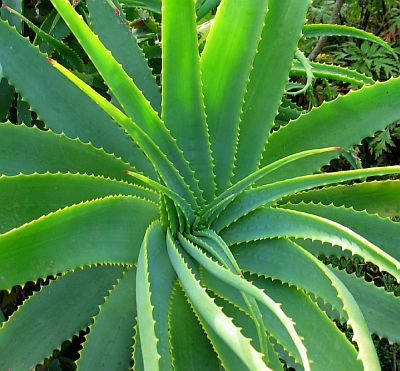 Aloe Vera seems to be everywhere these days, in sun creams, drinks, toothpaste, make up, soaps and even toilet roll! Although there are over 200 varieties of Aloe, it is the Aloe Barbadensis Miller (Aloe Vera) which has been been most commonly used for its medicinal properties. The Aloe leaf is made up of four components: Rind, Sap, Gel and Juice. The Gel (or Mucilage Gel) is the part of the plant most often used for medicinal purposes as it contains the 8 essential Amino Acids that the human body needs but cannot manufacture itself.
Aloe Vera has been used for centuries, with earliest records of its use as far back as 1500 BC in ancient Egypt! To this day Aloe Vera is used in Western medical science and is very popular modern herbal remedies and treatments.
Aloe Gel is often used topically as a soothing treatment for a variety of skin conditions. It is used to treat psoriasis, burns, frostbite, sores, sunburn and eczema. Research has shown that, taken orally, aloe gel can help to lower cholesterol levels in people with high cholesterol, and can help to lower blood glucose levels in people with type II diabetes.
Do you use aloe for anything?